How to Keep Your Agent Instructions from Going Stale
How to keep the instructions you give a coding agent from going stale.
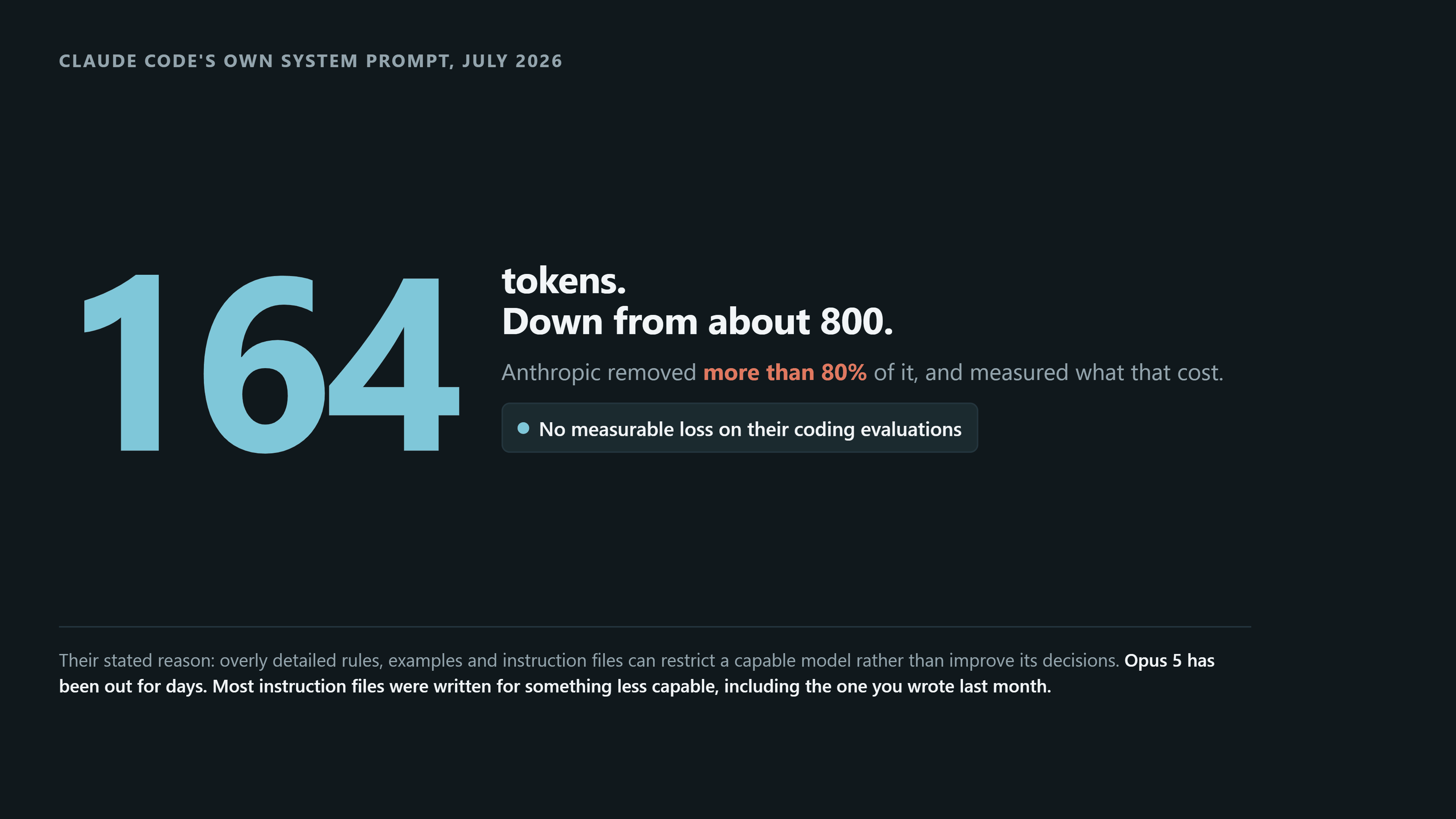
In July, Anthropic cut Claude Code’s own system prompt from roughly 800 tokens to 164. More than 80 percent removed, with no measurable loss on their coding evaluations. Their stated reason is worth sitting with: overly detailed rules, examples and instruction files can restrict a capable model rather than improve its decisions.
If that holds for the prompt written by the people who build the model, it holds for the rules file you wrote only a month ago. Opus 5 has been out for days. Most instruction files were written for something less capable.
Data table
| Measure | Value |
|---|---|
| System prompt before | ~800 tokens |
| System prompt after | 164 tokens |
| Reduction | over 80% |
| Measured loss on their coding evals | none |
| Published | 2026-07-24 |
Why instructions go stale in the first place
Most rules in an instructions file were written to compensate for something. The model did the wrong thing once, so you wrote a rule. That rule was correct on the day you wrote it.
Two things then happen without anyone touching the file.
The model gets better, and the weakness the rule was compensating for goes away. What is left is a paragraph of instruction spending context on a problem that no longer exists.
And the surrounding tooling starts doing the same job natively. The interface descriptions your agent already reads may now instruct the exact behaviour your rule spells out. At that point the rule is not just unnecessary, it is a second copy of an instruction that can drift from the first.
Neither of these announces itself. The file keeps working, so nobody re-reads it.
Data table
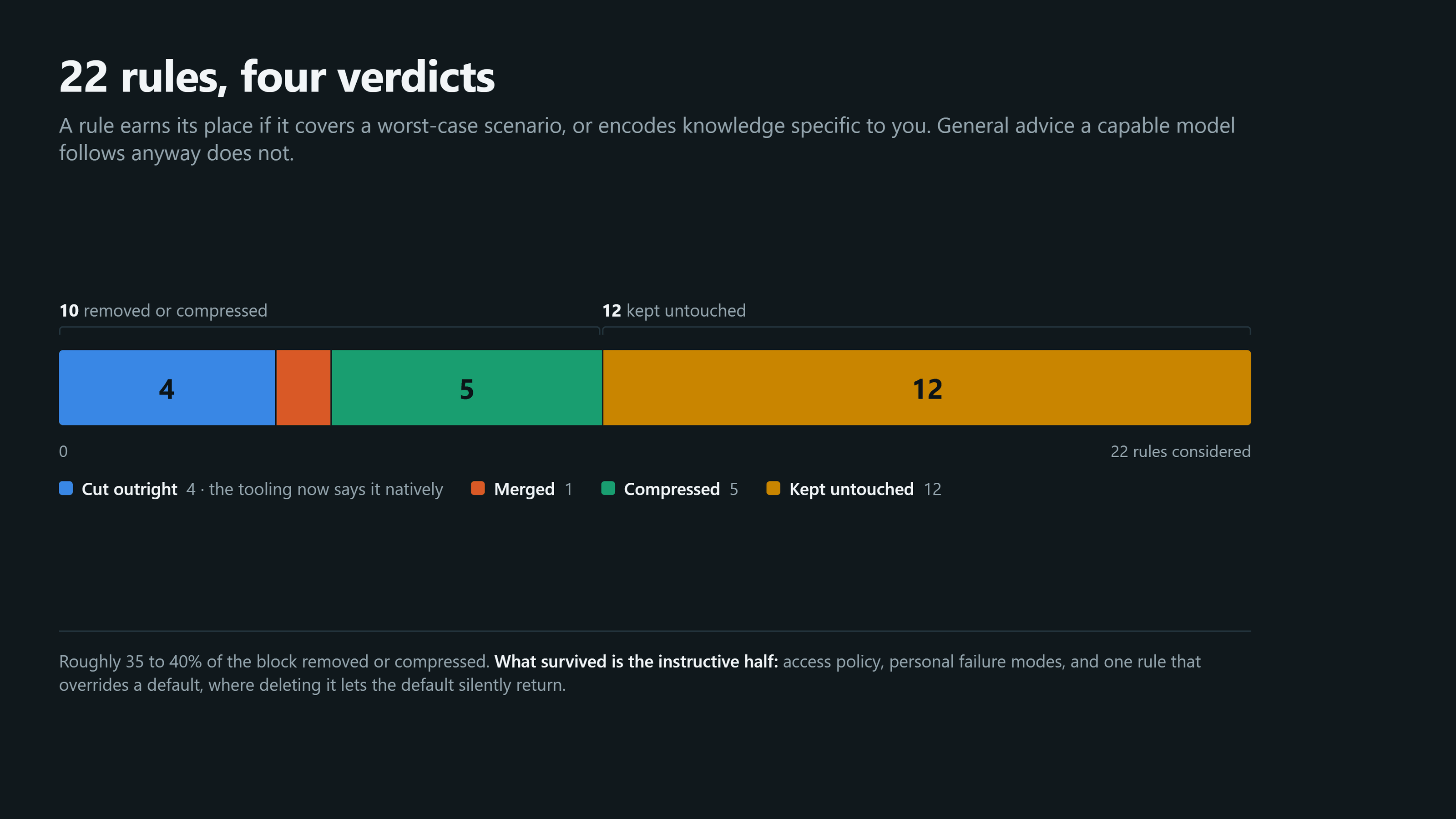
| Verdict | Rules | Reason |
|---|---|---|
| Cut outright | 4 | The tooling now instructs this natively |
| Merged | 1 | Two rules stating one constraint |
| Compressed | 5 | Intent kept, examples and enumerations dropped |
| Kept untouched | 12 | Worst-case scenarios, or specific to me |
How to decide what actually goes
The useful part of Anthropic’s guidance is a retention test, not a target percentage. A rule earns its place if it does one of two things: it addresses a worst-case scenario, or it encodes opinions, knowledge or practices specific to you. General advice a capable model would follow anyway does not qualify.
I ran that test across my own global rules, with every proposed change carrying a confidence grade for how certain it was that the change lost nothing. I approved the high and medium sets. Roughly 35 to 40 percent of the rules block came out or was compressed.
Two rules were removed because I compared them against the instructions the tooling itself already hands the agent, and found near-identical wording sitting there. I did not have to decide whether those rules were still useful; I could see they were duplicates. If you do one thing from this piece, start there: read what your tools already tell the agent, then delete your own copies of it.
What survived is as instructive as what went. Access policy stayed, because getting it wrong is a worst-case scenario. A rule that deliberately overrides a default behaviour stayed, and it is the strongest possible keep, because the moment it is deleted the default silently returns. Rules encoding my own repeated mistakes stayed, because a model has no way to know which errors I personally keep making.
Nothing structural was touched. Permissions and enforcement hooks are not advisory text, and the guidance does not apply to them.
Skills that review your other skills
This next part assumes something most people have not built yet, so it is worth explaining plainly before the rest makes sense.
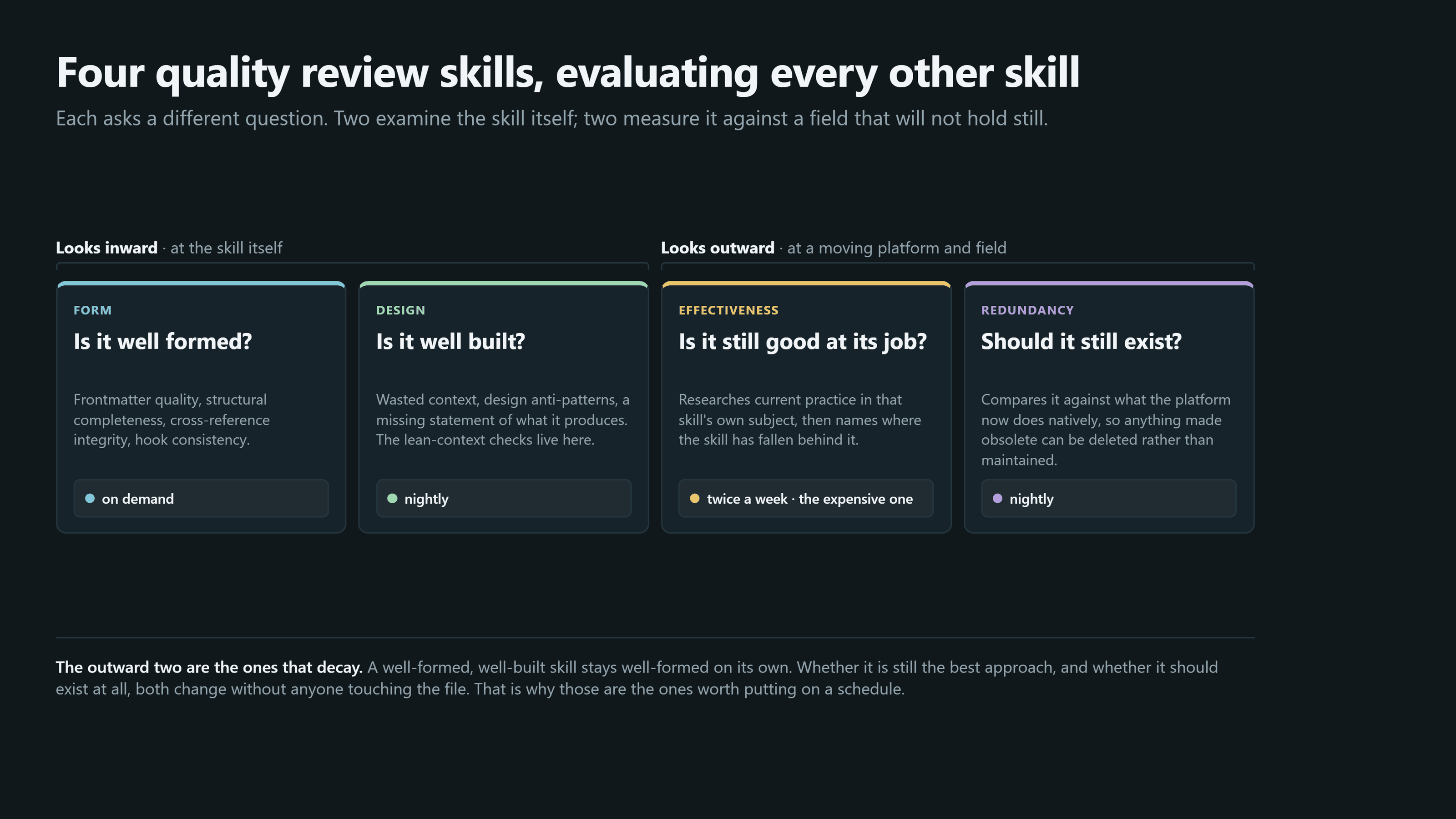
Alongside the skills that do my actual work, I keep a small set of skills whose only job is to review the others. One checks structure and health: is a skill well formed, are its references intact, does it declare what it produces. One reviews design quality: is it bloated, is it doing something the platform now does for me, is it clear about what it refuses to do. One researches the current state of the art for that skill’s subject and asks whether the skill is still good at its job. One compares each skill against what the platform can now do natively, so I can delete anything that has been made redundant.
That review layer is the thing worth copying from this piece. Instructions and tooling decay, and a capable reviewer that knows what good looks like can find the decay far faster than you will by reading your own files.
But building the reviewer is only half of it, and the half that is easier to get wrong is what makes it run.
Why an on-demand check cannot catch its own staleness
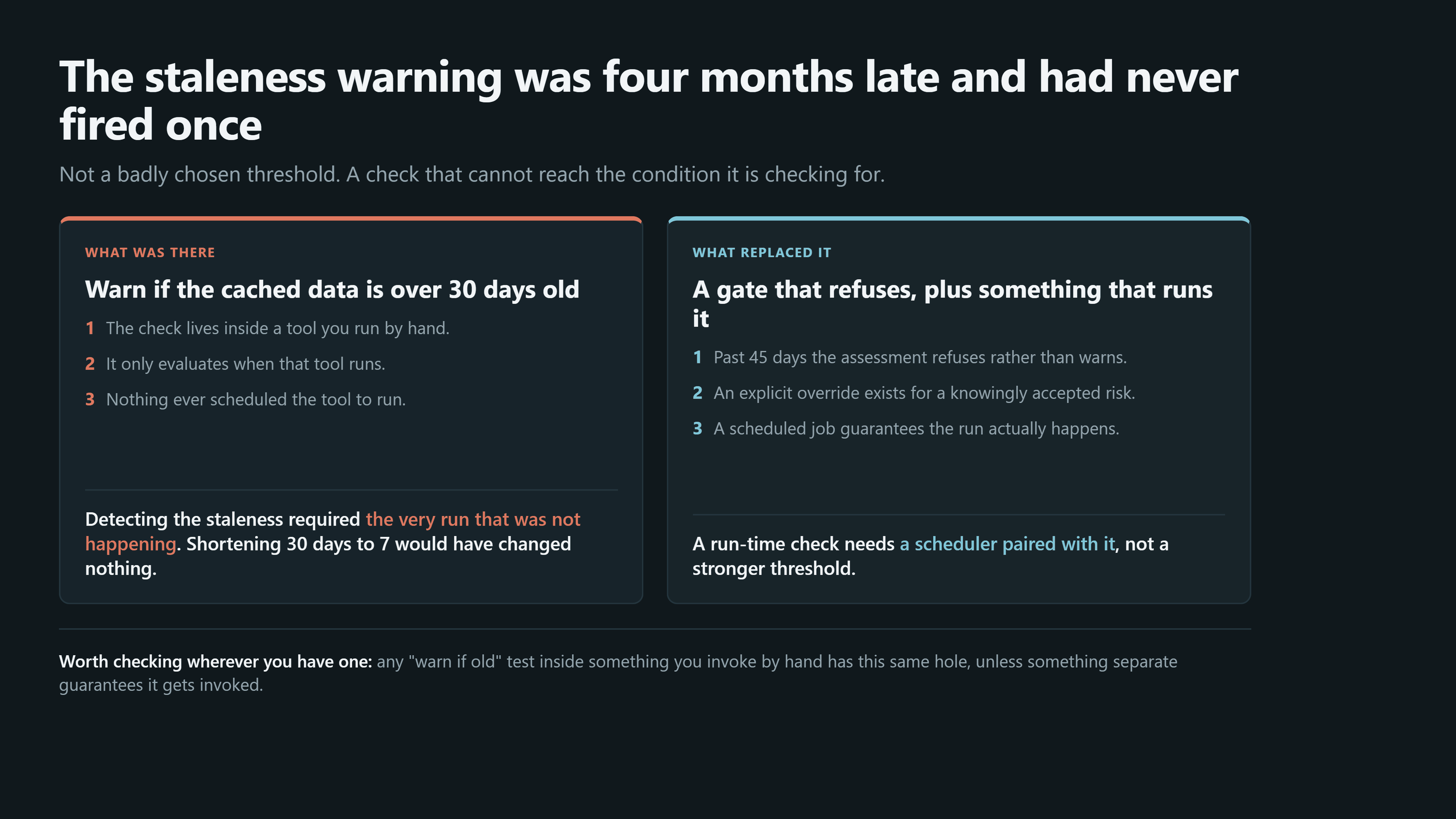
The skill that compares my skills against current platform capabilities keeps a cached inventory of what the platform can do. That inventory carried a warning: if it is more than thirty days old, say so. Reasonable design.
The inventory was over four months stale, and the warning never once fired.
The reason is structural, not a badly chosen number. The check only ran when the skill ran, and nothing ever caused the skill to run. Detecting the staleness required exactly the run that was not happening. Shortening thirty days to seven would have changed nothing.
So the fix was not a louder warning. It was a schedule.
Put plainly: a review that depends on you remembering to ask for it will not happen, because remembering is the part that fails. Put it on a timer and it happens whether or not you thought about it that week. The benefit is that drift gets caught on a cadence you chose, rather than whenever you happen to look, and you stop assuming your tooling is current when you have no evidence that it is.
The check itself also changed from a warning to a refusal. Past 45 days it will not run an assessment at all against stale data, with an explicit override for when you accept the risk knowingly. A warning is advice. A refusal is a decision.
What runs now
The rule is a new category on the review checklist with four checks: rules a capable model would follow anyway, examples that repeat what the tool already tells it, long specifications that belong in a separate file, and instructions that reimplement something the platform now does itself. The checklist is version stamped, so every review records which version it was judged against.
The job runs nightly and takes one or two skills at a time, oldest first. The expensive pass, the one that researches current best practice for each skill’s subject, runs twice a week instead of nightly.
The rule that makes it safe to leave running: it proposes, and never edits. No file changed, nothing committed. Findings land in a queue marked pending, and a notice when I start a session tells me how many are waiting. Keeping or dropping each one is my call, made in a normal working session.
That boundary matters more than the automation does. An unattended process allowed to edit your instructions can degrade them while you sleep, and you would find out slowly.
What the first night produced
It ran for the first time this morning and finished clean. Two skills reviewed, eight findings queued, nothing changed.
The findings are small and specific. One constraint stated four separate times in a single file. A fixed list of banned phrases being checked by reading when a search would do it properly. A missing completion line that the neighbouring skill already defines.
None of it is dramatic. All of it is the kind of thing that accumulates for a year and never rises far enough up anyone’s list to fix.
Data table
| First unattended run | Result |
|---|---|
| Started | 02:00:01 |
| Skills reviewed | 2 |
| Findings queued | 8 |
| Edits applied | 0 |
One scan, two destinations
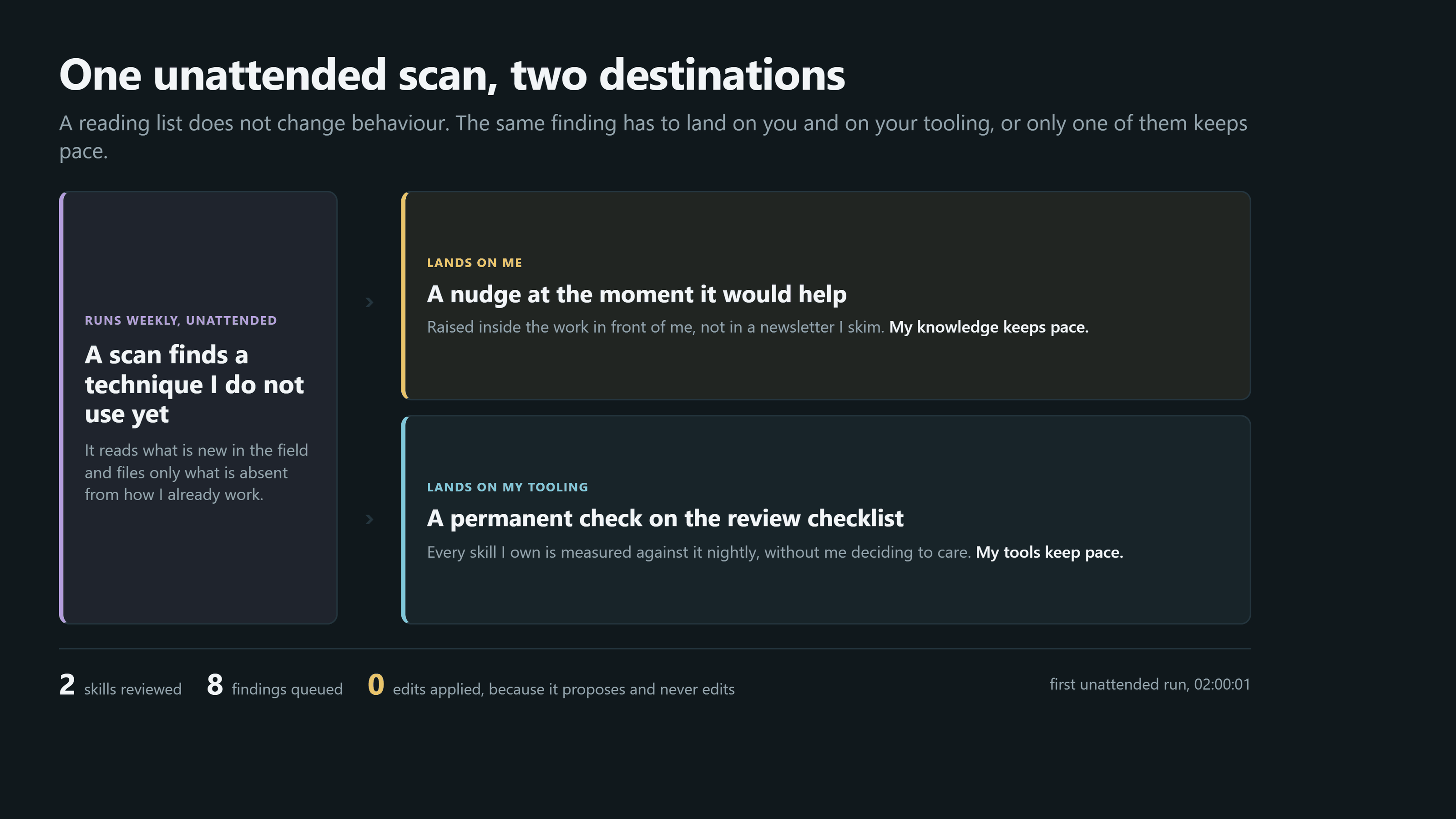
My Claude Code Coach has a frontier scan capability that scans weekly for new techniques and tools I am not using yet. The frontier scan sends its findings to two places.
One goes to me. When the scan finds something I do not do yet, it gets embedded into my coach’s frontier skills for it to coach me on, raised at the moment the work in front of me would actually benefit from it. Not a newsletter I skim. A nudge at the point of use.
The other goes to my tooling. The same finding becomes a check on the skill quality review checklist, and from then on every skill I own gets measured against it automatically, on a schedule, without me deciding to care.
That is the whole idea. One unattended scan keeps both halves current: what I am being coached on, and what my tools do. The field is moving faster than anyone can track by hand, and the answer is not to read harder. It is to have something read for you, teach you at the moment it matters, and hold your tooling to the same standard without being asked.
What this does not establish
One night is one night. Eight findings from two skills says the process produces output, not that the output is worth acting on. The real test is what fraction I keep versus drop over the next few weeks, and if most of it turns out to be not applicable, the best response is to drop the cadence or scrap it.
The percentage I cut may not be your percentage. Yours may be more or less than mine… so someone with leaner instructions would cut less, and someone with a file older than mine would cut more.
And the whole approach rests on the claim that current models need less instruction than older ones. That claim comes with evidence for Claude Code’s own prompt. It is reasonable to expect it generalizes, and it is not proven for your particular rules on your particular work.
The cleanup is not the achievement. Anyone can delete text once. The thing worth building is whatever notices, without being asked, that both you and your tools have fallen behind.